
Last updated October 15, 2026
Free written scope consultation - allowances, timeline, and change-order rules on paper before a single trade is scheduled
Construction Cost Breakdown: The Los Angeles Homeowner’s Reference for 2026
A kitchen remodel quoted at $85,000 in Los Angeles and one quoted at $55,000 may involve identical finishes. The $30,000 gap is almost entirely in permit fees, licensed labor rates, and engineer stamps that only one of those contractors is actually paying for. This guide breaks down where each dollar goes in a Los Angeles construction project, line by line, so you can evaluate quotes accurately instead of guessing which contractor is honest and which one is cutting corners you’ll pay for later. For DIY vs Professional Construction: The Los Angeles Homeowner’s Decision Guide on when to hire out, see our companion post. You’ll learn how LA City and LA County permit fee structures actually scale, what every trade charges in 2026, and how to spot buried overhead in a bid.
Quick Answer
Construction costs in Los Angeles in 2026 run roughly $150 to $450 per square foot for remodels and additions, depending on scope, finishes, and whether the work triggers seismic retrofit requirements. Permit fees typically add 6% to 12% of project valuation on top of construction costs, and licensed labor in LA runs 20% to 40% above the national average due to prevailing wage laws, union density, and the cost of living. A homeowner who can read a line-item estimate with visible labor, material, permit, and overhead percentages will save more money than one who shops for the lowest lump-sum number. See our deep dive on Construction Permits, Codes & Inspections in CA: What You Need to Know for jurisdiction-specific rules.
Styles & brands we work with







Table of Contents
- Why LA Costs Run Above National Averages
- How Permit Fees Actually Scale in Los Angeles
- Labor Rate Benchmarks by Trade for 2026
- Material Costs: Freight, Markups, and Lead Times
- When Engineering Stamps Are Required (and What They Cost)
- How to Read a Construction Quote in Los Angeles
- Finish Levels: What You’ll Pay at Each Tier
- Common Mistakes to Avoid
- When to Call a Professional
- Frequently Asked Questions
- The Bottom Line
Why LA Costs Run Above National Averages
Los Angeles construction costs are not higher because of one single factor. They are higher because four separate pressures compound on top of each other, and most national cost guides flatten these into a vague “regional multiplier” that tells you nothing about where your money goes. The first pressure is labor. Union carpenters, electricians, and plumbers in Los Angeles work under prevailing wage schedules that set base rates well above national medians, and the non-union market prices itself just below those rates. A framing carpenter who earns $32 an hour in Dallas earns $48 to $58 an hour in Los Angeles before benefits and workers’ comp. That difference lands directly on your invoice, and it is not negotiable if you want a licensed crew.
The second pressure is seismic engineering. Los Angeles sits in Seismic Design Category D, which means that alterations touching load-bearing walls, foundations, or roof structures trigger engineering review faster than in most of the country. A bathroom remodel that never needs an engineer’s letter in Phoenix may require a structural engineer’s stamp in LA because the city checks lateral resistance on any wall that carries shear force. That stamp is a line item, not a rounding error: expect $1,500 to $4,500 depending on the scope of the structural work.
The third pressure is permit cost. LA City and LA County both scale permit fees as a percentage of project valuation, and that valuation is set by the jurisdiction, not by what your contractor tells you the job is worth. On a $100,000 project, the all-in permit package often comes to $5,000 to $9,000 after plan check, inspection, and surcharge layers. On a $300,000 project, that climbs to $18,000 to $30,000.
The fourth pressure is freight and logistics. Every material delivered into the LA basin moves through congested ports, freeway corridors with truck-route restrictions, and warehouse networks that charge Southern California’s highest industrial rents in the nation. Lumber, tile, and stone arriving from Northern California, Mexico, or overseas all carry a freight surcharge that a homeowner in Kansas never sees on the same SKU. These four layers are not a markup. They are the cost of building in a dense, regulated, seismically active city.
How Permit Fees Actually Scale in Los Angeles
Here is what no generic construction cost guide will show you: the actual all-in permit cost for a Los Angeles project at two common valuation brackets. LA Department of Building and Safety (LADBS) and LA County Public Works both use a valuation-based formula. The building permit fee itself is calculated from a per-square-foot construction cost table that the jurisdiction publishes, not from a number your contractor submits. Valuation is largely non-negotiable, and plan check fees, inspection fees, and surcharges stack on top of the base building permit.
All-in permit cost, $100,000 valuation (LA City):
- Building permit base fee: $2,800 to $3,400 depending on occupancy type
- Plan check: 65% of building permit fee, roughly $1,800 to $2,200
- Mechanical, electrical, plumbing permits: $1,200 to $2,000 combined for a typical remodel
- LA City surcharges (general plan maintenance, development services, seismic): $600 to $1,000
- Total range: $6,400 to $8,600
All-in permit cost, $300,000 valuation (LA City):
- Building permit base fee: $8,500 to $10,000
- Plan check: $5,500 to $6,500
- M/E/P permits: $4,000 to $7,000
- Surcharges: $1,500 to $2,500
- Total range: $19,500 to $26,000
LA County unincorporated areas, including parts of Altadena, West Whittier, and Topanga, run through a separate fee schedule that lands within 5% to 10% of LA City numbers but with different payment triggers. In the city of Los Angeles, homeowners can pay plan check and permit fees online through LADBS. In county zones, the process flows through Public Works, and plan review on structural work often takes an extra two to four weeks because county engineers review more projects per capita than city reviewers. The takeaway: do not trust a quote that says “permits included” without a dollar figure attached. If the permit line is missing from your estimate, the contractor either has not priced it or does not plan to pull one. Either way, you need to ask before signing.
Labor Rate Benchmarks by Trade for 2026
Labor is the largest single line item on any Los Angeles remodel, typically 40% to 55% of total project cost. Knowing what each trade bills helps you spot a bid that is hiding margins or shorting crew expertise. The following rates reflect 2026 billable rates from Los Angeles contractors, meaning the amount charged to your job before any GC overhead. They include payroll taxes, workers’ compensation insurance, and the cost of paid time off that a legitimate contractor carries.
2026 LA trade rates (billable per hour, per worker):
- Framing carpenter: $78 to $110
- Rough/finish carpenter (custom millwork): $90 to $135
- Licensed electrician: $125 to $185
- Licensed plumber: $120 to $175
- Tile setter: $70 to $105
- Drywall/finisher: $65 to $90
- Painter: $60 to $85
- Demo laborer: $50 to $75
Union versus non-union context matters because it affects project sequencing and overtime. Union electrical and plumbing work in LA follows IBEW and UA Local 78 contracts, which carry higher base rates but also strict ratio and apprentice rules that some contractors price into their bids as a fixed scope cost, not an hourly wage. Non-union shops in LA bill slightly lower per hour but vary more in quality control. In our experience, an electrician billing $95 an hour in Los Angeles is either new, unlicensed, or cutting insurance coverage. A licensed, insured electrician will not bill below $120 an hour in this market in 2026. Ask a contractor whether their trades are W-2 employees or subcontracted 1099s because that changes workers’ comp coverage and who is liable if someone gets hurt on your property. A general contractor running subs without verifying their licenses and insurance is a common source of shattered budgets and litigation.
Material Costs: Freight, Markups, and Lead Times
Materials run 25% to 40% of total construction cost in Los Angeles, and the most misunderstood part of that number is freight. Every sheet of plywood delivered to a Los Angeles job site has passed through one of two supply chains: a rail-to-yard network if it came from the Pacific Northwest or Canada, or a port-to-warehouse network if it came from overseas. Both add 8% to 15% to the mill cost before a Los Angeles lumber yard even prices the board. When you buy from a large national big-box retailer, that freight is baked into the shelf price. When you buy from a specialty yard like Ganahl Lumber or Bourget Bros in Santa Monica, you pay a different line-item structure: better material, longer lead time, often a lower total on volume because there is no hidden retail margin.
Lead time is a cost, not an inconvenience. A custom cabinet order from KraftMaid or Wellborn currently runs 6 to 10 weeks in Los Angeles. Cambria, Silestone, and Caesarstone quartz tops run 2 to 5 weeks depending on color and fabrication backlog. Windows and doors from manufacturers like PGT and CGI in Florida can run 10 to 14 weeks, and every week of lead time is a week of carrying costs, storage, schedule risk, and often a second mobilization fee from your contractor. Specification-grade product choices like GAF or Owens Corning roofing materials maintain more stable inventory in LA because volume distributors stock them locally, but anything custom or semi-custom travels on a schedule you do not control.
When Engineering Stamps Are Required (and What They Cost)
In Los Angeles, a structural engineer’s stamp is required any time work alters a load-bearing wall, foundation, roof sheathing, or a shear wall, or when it adds a second story, a deck, or a retaining wall over 4 feet. The trigger is defined by LADBS plan check criteria, and it applies even when a contractor has done the same job 50 times without a permit. The stamp means a California-licensed civil or structural engineer has reviewed the design, run calculations on gravity and lateral loads, and sealed the drawings for submittal.
What engineering actually costs as a line item in LA:
- Structural review and stamped drawings for a simple wall removal (header over a 6 – 8 ft span): $1,500 to $2,800
- Engineering for a kitchen addition or load-bearing reconfiguration: $3,000 to $6,000
- Foundation retrofit or soft-story work with lateral analysis: $4,500 to $10,000 and up
- Title 24 energy calculations (always required for envelope work): $800 to $2,000
If a Los Angeles contractor tells you the engineering is “included” but has no dollar amount for it and no named engineer on the drawings, treat the quote as a sketch, not a bid. The engineer is the first paid check in a permitted job, and if the plans have no stamp, LADBS will reject the submittal and your schedule resets to zero. We see this in Los Angeles consistently: a remodel gets quoted without engineering, the homeowner signs, the job stalls at plan check, and a change order appears for $4,000. A quote that shows the engineering fee as its own line item tells you the contractor has actually done the project before. A quote that hides it tells you the contractor is betting you will not ask.
How to Read a Construction Quote in Los Angeles
A construction quote in Los Angeles is readable in about four minutes if you know the four percentages that should be visible. Overhead, profit, contingency, and insurance should each be identifiable, and when they are buried, the bid is hiding one of two things: a margin the contractor does not want defended, or a scope gap that will appear later as a change order.
What each percentage should reasonably be in LA in 2026:
- Overhead: 10% to 15% of construction cost. This covers office rent, software, phones, insurance premiums beyond workers’ comp, and the cost of running the business. If overhead is shown at 25% or higher, ask what is in it. If overhead is absent, it is buried in the labor and material line items, which makes comparison shopping impossible.
- Profit: 8% to 15%. Contractors in LA have been pushing this higher since 2022 because the cost of carrying risk rose. Ten percent is a healthy margin for a mid-sized remodeling company. Fifteen percent shows up on complex, permit-heavy work where the GC is the one absorbing schedule risk.
- Contingency: 5% to 10%. Every serious Los Angeles quote should include a contingency line. In older homes, 10% is the right number because studs are never square and pipes are never where the drawings say they are. A quote with zero contingency will generate change orders the first week demo starts.
- Insurance: 2% to 4%. Workers’ comp and general liability for a residential remodeler in California run high. This should appear as a direct cost or within overhead, but a contractor should be able to show you the cost if asked.
Read the quote in this order: permit line, engineering line, contingency, labor hours per trade, material allowance, overhead and profit. If any one of those is missing or described as “included,” you are comparing apples to a blank line. The General Contractor in Los Angeles you choose should be able to explain every percentage on the page without getting defensive. If they can not, keep looking.
Finish Levels: What You’ll Pay at Each Tier
Finish levels explain why two kitchens in the same Los Angeles zip code can be priced $40,000 apart with identical cabinet layouts. The difference is in material grades, not in contractor greed. Here is what builders in LA actually charge by tier for common remodel scopes in 2026.
Kitchen remodel, per tier, Los Angeles 2026:
- Budget ($45,000 to $70,000): Stock or semi-custom cabinets from a national line, mid-grade quartz or granite in a limited color range, porcelain tile backsplash, mid-range faucets and stainless sink, no layout changes beyond appliance swapping. No engineering. Permits only if no plumbing or electrical moves.
- Mid-range ($75,000 to $120,000): Semi-custom cabinets from lines like KraftMaid or Wellborn, Cambria or Silestone quartz, Schluter waterproofing systems in the wet zones, Kohler or Moen fixtures, layout changes with minor structural work. Engineering likely for a wall opening. 8 to 12 week timeline.
- High-end ($135,000 to $220,000 and up): Custom cabinets, specification-grade stone, Toto or Grohe fixtures, structural changes with full engineering, lighting design, appliance packages from Sub-Zero/Wolf or Thermador. 14 to 24 week timeline.
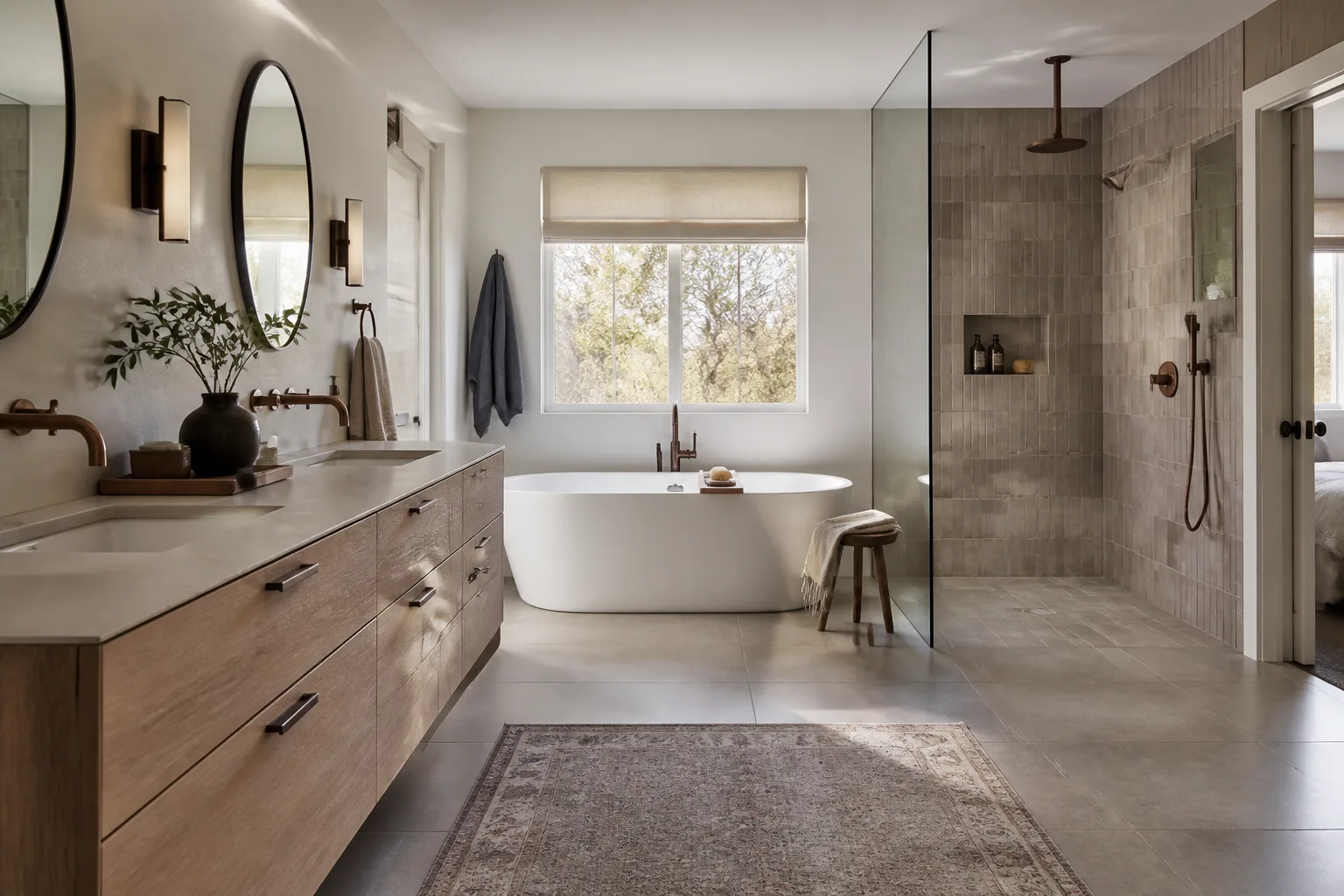
Bathrooms follow a similar curve. A basic full bath refit in Los Angeles runs $35,000 to $55,000. A primary bathroom with floor-to-ceiling tile, custom vanity, a curbless shower with linear drain, heated flooring, and a freestanding tub runs $80,000 to $140,000. When a bid is below the floor for its tier, you are not getting a deal; you are getting a different scope or a different standard of care. A Bathroom Remodeling in Los Angeles project priced at $28,000 for a full gut is missing waterproofing, engineering, a licensed plumber, or all three because the materials alone for a proper shower build in LA cost more than half that number.
See the difference
 Before
 After
After Before
 After
After Before
 After
AfterCommon Mistakes to Avoid
- Comparing lump-sum bids without line items. Two quotes may both say $85,000 for a kitchen, but one includes engineering, permits, contingency, and a named crew; the other bundles everything into “scope of work” and hopes you never ask. You cannot compare what you cannot see, and in Los Angeles the invisible lines are often more expensive than the visible ones.
- Treating permit costs as optional or negotiable. LADBS does not negotiate fee schedules. A contractor who says they can “save you money by skipping the permit” is not doing you a favor; they are transferring all liability to you at resale, insurance-claim, or inspection time.
- Assuming the lowest material allowance is the best value. A quote with a $4,000 cabinet allowance sounds cheaper until you discover the allowance does not cover a single semi-custom kitchen from any brand you have heard of. Allowances are where under-quoting contractors hide their margin: the job starts, the allowance runs out, and the change order arrives.
- Ignoring lead time in your move-in calendar. Custom millwork, stone fabrication, and window orders from Florida manufacturers like PGT and CGI can add 3 to 4 months to a project in Los Angeles. Signing a contract before materials are ordered starts the clock on your schedule, and schedule overruns in LA carry real carrying costs.
- Skimping on contingency in an older Los Angeles home. 1920s bungalows in Highland Park and 1950s tract homes in the Valley share two traits: hidden settling and undocumented previous renovations. Without a 10% contingency, the first surprise inside the wall becomes an adversarial conversation instead of a scheduled line item.
- Not verifying that the crew has already passed a background check. In a city of 4 million people, a general contractor who will not tell you who exactly is coming to your house before the job starts is a contractor to avoid. You should know the name and face of every person who steps inside.
When to Call a Professional
If your project touches structure, plumbing, electrical, waterproofing, or exterior envelope work in Los Angeles, you need a professional. Structural changes require the engineer’s stamp we covered above, and unpermitted structural work discovered during a future sale can kill a deal in escrow. Waterproofing failures in LA bathrooms are among the most expensive repairs we see because they often go unnoticed for years behind tile and sheetrock. And any project that needs three or more trade specialties coordinated on one schedule, a kitchen with cabinet, stone, plumbing, electrical, and tile, for example, is beyond the practical reach of a homeowner managing it piecemeal. Mason Remodeling Co Los Angeles offers free estimates in Los Angeles, call (213) 632-5711 or use our Home Remodeling in Los Angeles page to learn more about what a written, line-item bid looks like. You can also start with our Mason Remodeling Co Los Angeles home page to understand what we do and how we deliver it.
Frequently Asked Questions
A mid-range remodel in Los Angeles runs $200 to $350 per square foot, while additions and higher-end finish work run $350 to $450 per square foot and up. The wide range exists because Los Angeles permit fees, seismic engineering requirements, and labor rates vary depending on the scope, the age of the structure, and whether the project is in LA City or LA County jurisdiction. Budget tier work can be done for $150 to $200 per square foot if the structure is untouched and finishes are entry-grade. Call (213) 632-5711 for an exact quote, estimates are free.
Los Angeles construction is expensive because four costs stack on each other: prevailing-wage labor rates 20% to 40% above the national median, seismic engineering requirements in Seismic Design Category D, permit fees that scale as a percentage of project valuation, and freight surcharges on every material that enters the LA basin. No single factor explains the premium, and a contractor who blames one thing is oversimplifying.
You need a structural engineer any time your remodel touches a load-bearing wall, foundation, roof sheathing, shear wall, second story, deck, or retaining wall over 4 feet. LADBS plan check will reject drawings without a California-licensed engineer’s stamp on structural work. Engineering costs $1,500 to $6,000 for typical remodels and rises for foundation or lateral work. Call (213) 632-5711 to see where your project falls.
Permits for a $100,000 project in Los Angeles cost roughly $6,400 to $8,600 all-in, including building, plan check, MEP, and surcharge layers. A $300,000 project carries $19,500 to $26,000 in permit costs. The fee schedule is valuation-based and set by LADBS or LA County Public Works, not by your contractor. If a quote does not show a permit line with a dollar figure, ask why.
Fair overhead in Los Angeles is 10% to 15% of construction cost, and fair profit is 8% to 15%, depending on project complexity and risk. Contingency should be 5% to 10%, with 10% appropriate for older Los Angeles homes. A written quote should show these as visible lines, or at least be able to explain them clearly. Any contractor that can not explain its percentages is not being transparent with you.
The price should not change unless the scope changes, and a written contract with a visible contingency line is the best protection against surprise change orders. In Los Angeles, underground conditions like cast-iron drain lines in 1950s slab foundations are a legitimate source of change orders, but those should be anticipated in a well-built quote, not discovered after demo. Ask for the contingency percentage before you sign.
The Bottom Line
Los Angeles construction costs in 2026 are high for reasons you can see and verify: labor rates driven by prevailing wage, permit fees that scale by valuation, seismic engineering that adds line items other cities never see, and freight costs baked into every material delivery. The homeowner’s job is not to find the cheapest number. It is to find the quote that shows where each dollar goes so that you are paying for real scope, real permits, real engineering, and real crew members whose names and faces you know before they arrive. The contractor who shows you the line items is the one building a project you can stand behind. The contractor who hides them is building a change order. Browse more guides & resources to keep your project on track.
Contact Mason Remodeling Co Los Angeles
If you are planning a construction project in Los Angeles and want a written, line-item estimate that shows labor, materials, permits, engineering, and margins in plain view, we would rather show you than tell you about it. Every project we quote comes with a written price before work begins, period. Every crew member is identity-verified and introduced to you by name and photo before they step on your property. And every completed project carries our 365-Day Done Right Promise: if the work is not right within a year of completion, we make it right at no cost to you. Call (213) 632-5711 to schedule your free estimate in Los Angeles.
Written by Isaac Pruett, Owner at Mason Remodeling Co Los Angeles, serving Los Angeles since 2004.


