
Free written scope consultation - allowances, timeline, and change-order rules on paper before a single trade is scheduled
James Hardie Driveway & Pavers: The Los Angeles Owner’s Guide
James Hardie doesn’t make driveway pavers or paver systems, and that’s the first thing you should know before you spend another hour on hold. What Los Angeles homeowners actually need is a contractor who understands how Hardie siding, trim, and fascia integrate with driveways, walkways, and paver hardscaping at the transition points where these materials meet. We stock and install Hardie-compatible trim, flashing, and paver systems from Techo-Bloc and Belgard, with typical installed paver driveway work in Los Angeles running $8,260 – $21,240 depending on square footage, base condition, and drainage requirements.
Most owners discover the problem the same way: water pooling against the garage slab after rain, a Hardie plank wicking moisture where it meets the paver line, or a paver edge that’s begun to sink and pull the trim away from the house. The failure usually isn’t the Hardie product itself. It’s what happens where two different systems meet, and nobody planned for how they’d behave together over ten Los Angeles summers and a couple of El Niño winters.
Which James Hardie Models This Applies To
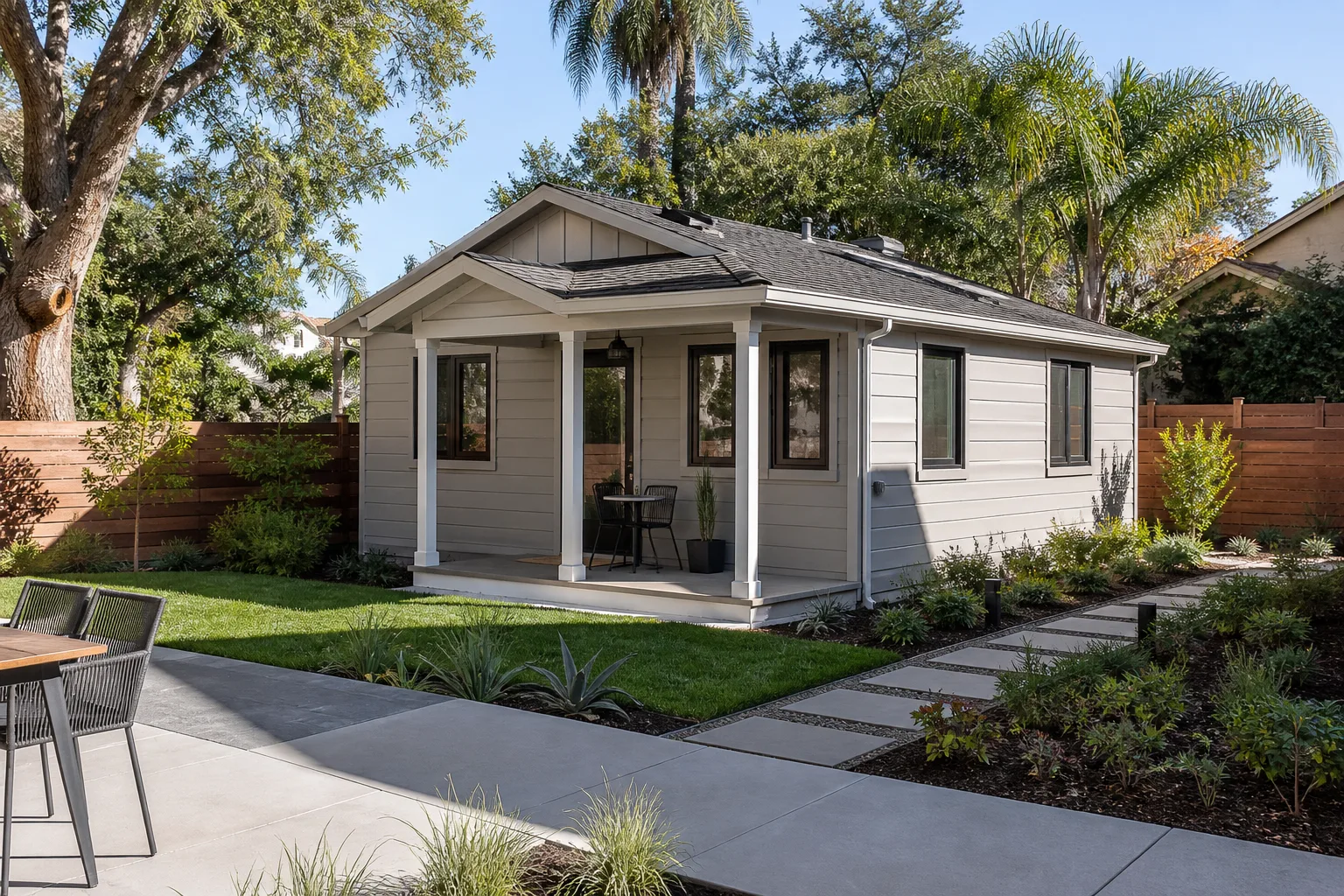
This matters for any HardiePlank lap siding, HardiePanel vertical siding, or HardieTrim board that terminates at or near a driveway, walkway, or paver patio. The failure point is almost always the bottom edge: Hardie products require a minimum 6-inch clearance from soil and a 2-inch clearance from hardscape like concrete or pavers. When a paver driveway is installed too high against the house, that clearance disappears, and Hardie fiber cement starts absorbing ground moisture like a wick.
If you’re looking at the side of your house and can’t tell which Hardie product you have, check the back of a loose board or the printed edge label. HardiePlank lap siding is 5/16-inch thick and comes in 12-foot lengths. HardiePanel is 5/16-inch as well but in 4×8 or 4×10 sheets. HardieTrim boards run 3/4-inch thick. The compatibility gotcha most Los Angeles owners hit: Hardie’s warranty explicitly excludes damage from improper clearance to hardscape, so the “failed part” is often not the siding at all. It’s the paver installation that never should have been poured that high in the first place.
For replacement fiber cement, we use genuine James Hardie product. For the pavers and base work, we spec Techo-Bloc and Belgard, both of which hold up to Southern California’s UV load and our wet-dry winter cycles better than big-box alternatives. Mason Remodeling Co Los Angeles is an independent service provider, not a James Hardie affiliate, which means we tell you when the Hardie product is fine and the hardscape is the problem.
Styles & brands we work with







Signs Your James Hardie Driveway & Pavers Is Failing
- Swelling or bubbling at board bottoms near the paver line. Fiber cement absorbs moisture when it’s in constant contact with damp hardscape or soil, and the bottom edge swells first. In Los Angeles, this shows up most often on north-facing walls where the ground never fully dries after winter rains.
- Paver settling that drops the hardscape below the siding’s required clearance. When the base under pavers compacts or washes out, the whole surface tilts toward or away from the house. That tilt changes the gap between paver and siding, and whatever water flows now flows against your Hardie product.
- Crumbling caulk or missing sealant where trim meets driveway pavers. The joint between HardieTrim and hardscape is a maintenance point. In Los Angeles heat, that sealant bakes and cracks within five to seven years, opening a water path into the wall assembly.
- Efflorescence or mineral streaking on paver faces near the house. White chalky residue on pavers means water is moving through the paver system and evaporating at the surface. That same water is touching whatever siding or trim sits just above it.
- Rust stains or displaced edge restraints along the driveway border. When plastic edge restraints fail and steel or aluminum edging shifts, the paver field begins to spread. The first visible clue is a widening gap at the edge, then pavers that rock underfoot near the house line.
See the difference
 Before
 After
After Before
 After
After Before
 After
AfterReplacement Cost & What’s Included
Paver driveway installation in Los Angeles runs $8,260 – $21,240 as a complete job, including demolition of the existing surface where needed, base preparation, geotextile fabric, bedding sand, pavers, edge restraint, and polymeric joint sand. Smaller paver patio or walkway work around the house starts near $4,130 and typically lands between $4,130 and $12,980. If the only issue is Hardie siding or trim replacement where it meets the hardscape, that’s priced per linear foot and usually runs far less than the paver work.
What drives the range: access to the site, whether the existing base is salvageable, drainage corrections that need to happen before your Hardie clearance problem goes away, and whether we’re resetting 6 or 60 square feet of edge pavers. You get a written line-item price before anything starts. No change orders invented mid-job, no cost overruns that show up on the final invoice. Every paver and Hardie-compatible trim installation we complete in Los Angeles is covered by our 365-Day Done Right Promise, which protects the work for one full year from the completion date.
DIY or Call Us?
You can safely check a few things yourself. Look at the clearance between the bottom edge of your Hardie siding and the paver surface. If it’s less than 2 inches, you’ve found the problem. Check whether pavers near the house rock underfoot. Look for cracks in the caulk line where trim meets hardscape. Those observations will tell you a lot and cost you nothing.
Where DIY goes wrong: fiber cement dust from cutting Hardie product is a silica hazard, and cutting it without proper dust control is not a weekend project. Resetting pavers against a house requires understanding drainage slope, base compaction, and edge restraint, and doing it wrong means the same failure returns in eighteen months. If the job involves moving significant hardscape, or if your Hardie clearance issue has already caused wall damage, call us at (213) 632-5711 and we’ll put the fix in writing before a single tool comes off the truck.
FAQs
James Hardie siding itself carries a 30-year limited warranty and should last that long in Los Angeles climate, but that warranty assumes proper clearance from hardscape and soil is maintained. Real-world Southern California failure along paver lines almost always traces back to clearance, drainage, or sealant failure within the first decade, which is a hardscape problem, not a siding defect.
Call (213) 632-5711 and we’ll inspect the transition point and tell you which side failed first.
Yes, in most cases the edge pavers nearest the house can be lifted, the base re-compacted, and the pavers reset with new edge restraint and joint sand. Full driveway replacement only becomes necessary when the base itself has failed across a wide area or drainage correction requires regrading the entire surface. Call (213) 632-5711 for a written estimate on the repair scope.
Most edge repairs, trim replacements, and sealant work finish in one to two days. A full paver driveway replacement in Los Angeles typically takes three to five working days depending on square footage and access. We give you a written schedule before work starts.
We keep common James Hardie trim profiles and standard Techo-Bloc and Belgard paver lines stocked locally and can usually start within days. Specialty Hardie colors or non-stocked paver styles may require a lead time, which we’ll confirm in writing before you commit. Call (213) 632-5711 and we’ll check availability for your exact product while you’re on the phone.
Written by Isaac Pruett, Owner, Mason Remodeling Co at Mason Remodeling Co Los Angeles, serving Los Angeles and nearby areas.


